

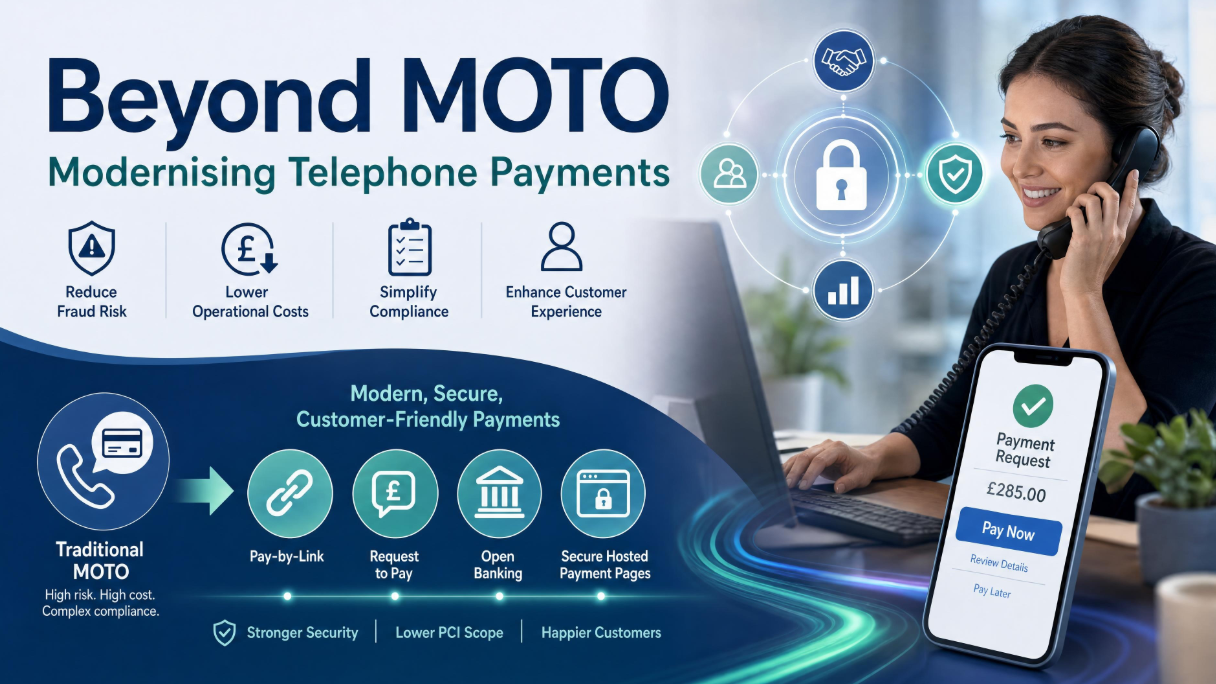
Beyond MOTO: Modernising Telephone Payments
Telephone payments still support accessibility, trust, and assisted selling in UK retail. Traditional MOTO card capture is becoming harder to justify as fraud, PCI-DSS cost, and customer expectations change.
Introduction
Telephone payments, commonly referred to as Mail Order / Telephone Order (MOTO) transactions, continue to play an important role within the UK retail sector. While no longer a mainstream payment channel, MOTO remains valuable for customers who require personal assistance, reassurance, accessibility support, or an alternative to online purchasing.
However, the characteristics that make telephone payments attractive — human interaction and simplified purchasing also attract:
- higher fraud risk
- increased operational costs
- PCI-DSS compliance obligations
In addition, changing consumer expectations and growing concerns around payment security are making traditional verbal card capture less desirable for both retailers and customers.
As a result, retailers are increasingly seeking ways to preserve the benefits of assisted sales and customer support while modernising the payment process.
What are MOTO Payments?
Mail Order / Telephone Order (MOTO) payments are Card-Not-Present (CNP) transactions in which a customer purchases goods or services remotely, typically by telephone. In a typical retail environment, a customer contacts a sales or customer service representative, confirms their order, and will provide their payment card details to complete the purchase.
Unlike most e-commerce card transactions, MOTO payments are generally exempt from Strong Customer Authentication (SCA) requirements under UK payment regulations. While this simplifies the checkout process, MOTO transactions do not benefit from the additional authentication used to reduce fraud in other secure payment channels.
Why Telephone Payments Are Still Important
Despite the growth of e-commerce, telephone payments continue to fulfil several important customer and business needs.
Customer-led drivers
- Accessibility requirements
- Preference for human interaction
Business-led drivers
- Complex sales requiring advice, order configuration, and cross-selling opportunities
- High-value purchases where assisted selling can improve customer confidence and conversion
- Complex customer service interactions, such as pre-orders, order amendments, partial refunds, bespoke orders, or assisted payment support, which can also create opportunities for additional sales and revenue generation
Benefits and Operational Challenges
Whilst MOTO can provide significant value for complex customer journeys, high-value purchases, and assisted sales, the manual support required to complete simpler transactions increases processing costs compared with digital self-service channels.
Manual card entry can increase call handling times, introduce processing errors, and create unnecessary friction for both customers and agents. In addition, MOTO transactions typically attract higher processing costs and greater fraud exposure than authenticated digital payment journeys.
Many customers are also becoming increasingly reluctant to verbally share payment card details due to growing awareness of fraud and data privacy. As digital payment channels become more secure through stronger authentication and fraud controls, fraudsters are increasingly targeting less secure channels such as MOTO.
Together, these operational, security, and customer experience challenges are encouraging retailers to explore secure payment options such as:
- Pay-by-Link
- Open Banking
- Request to Pay
- Secure hosted payment pages
enabling them to retain the benefits of assisted selling while improving security, reducing payment friction, and alleviating the need to handle sensitive payment card data.
Fraud and Security Risks
Traditional MOTO payments present a higher fraud risk than authenticated digital payment channels because they do not benefit from the additional customer authentication available in many modern payment methods. In addition, merchants typically retain liability for fraudulent MOTO transactions and associated chargebacks, making effective fraud prevention an important commercial as well as security consideration.
Common MOTO fraud risks include the use of stolen payment card details obtained through phishing attacks, data breaches, or criminal marketplaces; account takeover through compromised customer credentials; friendly fraud and chargebacks where legitimate transactions are disputed; social engineering aimed at bypassing verification procedures; and insider threats arising from the handling of sensitive payment information by employees.
Consequently, card issuers typically assess MOTO transactions as presenting a higher fraud risk, increasing the likelihood that genuine transactions may be declined and making it more challenging for retailers to maintain conversion rates.
Fraud Risk Management
Effective fraud prevention extends beyond individual controls and should form part of a broader fraud management strategy.
Where a transaction presents a higher fraud risk, retailers may choose to redirect the customer to a secure payment channel, enabling additional authentication and reducing fraud risk.
Depending on the payment provider and business requirements, advanced authentication capabilities such as EMV 3-D Secure Requestor Initiated (3RI) messaging and De-coupled Authentication may also provide opportunities to strengthen security while maintaining a seamless customer experience.
PCI-DSS Considerations
Where MOTO payments involve the manual handling of payment card data, they introduce additional PCI-DSS compliance obligations compared with many digital payment journeys. Organisations accepting telephone payments need appropriate controls to protect cardholder data during capture, transmission, processing, and storage.
Telephone payment environments present risks where payment details are spoken aloud, captured in call recordings, or processed on agent workstations. Consequently, retailers often face a broader PCI-DSS assessment scope and increased compliance costs.
To reduce both fraud and compliance exposure, many retailers are replacing traditional verbal card capture with technologies such as DTMF masking and automated Interactive Voice Response (IVR) payment services. These approaches remove sensitive payment card data from the conversation, reducing the handling of cardholder data while maintaining a telephone-based payment journey. Depending on the payment architecture adopted, they can also help reduce PCI-DSS scope and simplify compliance obligations.
Emerging Alternatives to Traditional Telephone Payments
Where the telephone conversation is primarily used to support the sales process and the customer is comfortable completing payment through a secure digital channel, retailers can achieve a better balance between customer experience, operational efficiency, fraud management, and compliance. This approach enables businesses to retain the benefits of assisted selling while modernising the payment journey.
Secure Digital Payment Requests
Pay-by-Link solutions allow an agent to initiate a secure payment request while remaining on the call with the customer. Depending on the retailer's preferred customer journey, the customer may complete the payment by accessing a secure payment page through a trusted channel, such as their online account, a customer portal or via a secure payment link where appropriate.
Where card payments are used, Pay-by-Link enables the transaction to be processed as a secure e-commerce payment rather than a traditional MOTO transaction, allowing retailers to retain the benefits of assisted selling while reducing fraud exposure and PCI-DSS scope.
Request to Pay (RtP)
Request to Pay is an emerging secure messaging capability developed by Pay.UK as part of the UK payments ecosystem. It enables retailers to send a payment request to a customer through a trusted payment channel, allowing the customer to decide how and when to make payment.
Unlike traditional MOTO transactions, Request to Pay does not require customers to share payment card details with the retailer. Instead, customers can review, approve, decline, defer, or in some implementations partially fulfil a payment request, making it well suited to use cases such as deposits, balance payments, instalments, or outstanding invoices.
Open Banking Payments
Open Banking enables customers to authorise account-to-account payments directly through their banking application using Strong Customer Authentication (SCA). Within an assisted telephone journey, the retailer can initiate a secure payment request through a trusted channel, such as a hosted payment page or customer portal, while remaining on the call with the customer. The customer authenticates the payment within their banking application, after which the retailer receives confirmation that the payment has been authorised and can complete the sale.
Strategic Recommendations
Telephone payments continue to provide value for specific customer groups and retail use cases. Retailers should focus on using the most appropriate payment journey for each customer while reducing reliance on verbal card capture wherever possible.
Secure Unavoidable MOTO Payments
Eliminate direct verbal card capture by adopting technologies such as DTMF masking or automated IVR payment services. Adopt solutions that prevent payment card data from being captured within call recordings, employee workflows, or internal systems, reducing fraud exposure and helping minimise PCI-DSS compliance scope.
Modernise Assisted Payment Journeys
Explore the emerging alternatives to a MOTO transaction. Where customers are comfortable using digital payment methods, adopt secure, customer-controlled payment journeys that separate the sales conversation from payment authentication, selecting the approach that best aligns with the retailer's business model, customer needs, and risk profile.
Strengthen Fraud and Compliance Controls
Implement a layered fraud management strategy that combines transaction risk scoring, AVS, CVV verification, behavioural analytics, delivery validation, and clear decisioning rules for higher-risk transactions. Where an elevated fraud risk is identified, consider redirecting customers to secure authenticated payment channels if feasible.
Measure Customer and Business Outcomes
Regularly review customer adoption, conversion rates, fraud losses, chargebacks, payment completion rates, compliance costs, and customer satisfaction to evaluate the effectiveness of assisted payment journeys and identify opportunities for continuous improvement.
Conclusion
Telephone payments remain a relevant part of the UK retail landscape because they support accessibility, trust, and assisted selling. However, increasing fraud risks, growing compliance obligations, and evolving customer expectations are accelerating the shift away from card capture over the telephone.
The future of assisted retail payments is likely to combine human interaction with secure digital payment technologies such as Pay-by-Link, Request to Pay, Open Banking, and automated payment capture. Retailers that successfully embrace this transition will be better positioned to reduce operational risk, simplify compliance obligations, improve customer experience, and maintain competitive advantage as payment preferences continue to evolve.
Retail Perspective #9 : Telephone Payments