

Pay by Bank: A Strategic Payment Option for UK Retailers?
Evaluating its role in cost optimisation, customer experience, and payment strategy
Executive Summary
The UK payments landscape is evolving as new payment methods emerge alongside established card networks. While cards continue to dominate retail transactions, Pay by Bank, an account-to-account payment method powered by Open Banking, is gradually being introduced as an additional option within the payments mix.
Rather than replacing existing payment methods, Pay by Bank should be viewed as a complementary option. Its suitability depends on a retailer’s business model, sales channels, operational capabilities and overall payments strategy.
While some large retailers and marketplaces have begun offering Pay by Bank, adoption across the market remains at an early stage and its long-term trajectory remains uncertain.
For most retailers, Pay by Bank is unlikely to replace cards in the near term but may offer targeted value in specific use cases such as high-value transactions or cost-sensitive payment flows.
The Emergence of Pay By Bank
Card payments remain the dominant method in UK retail. However, they incur transaction fees, settlement delays (typically 1–3 days) and exposure to chargeback risks.
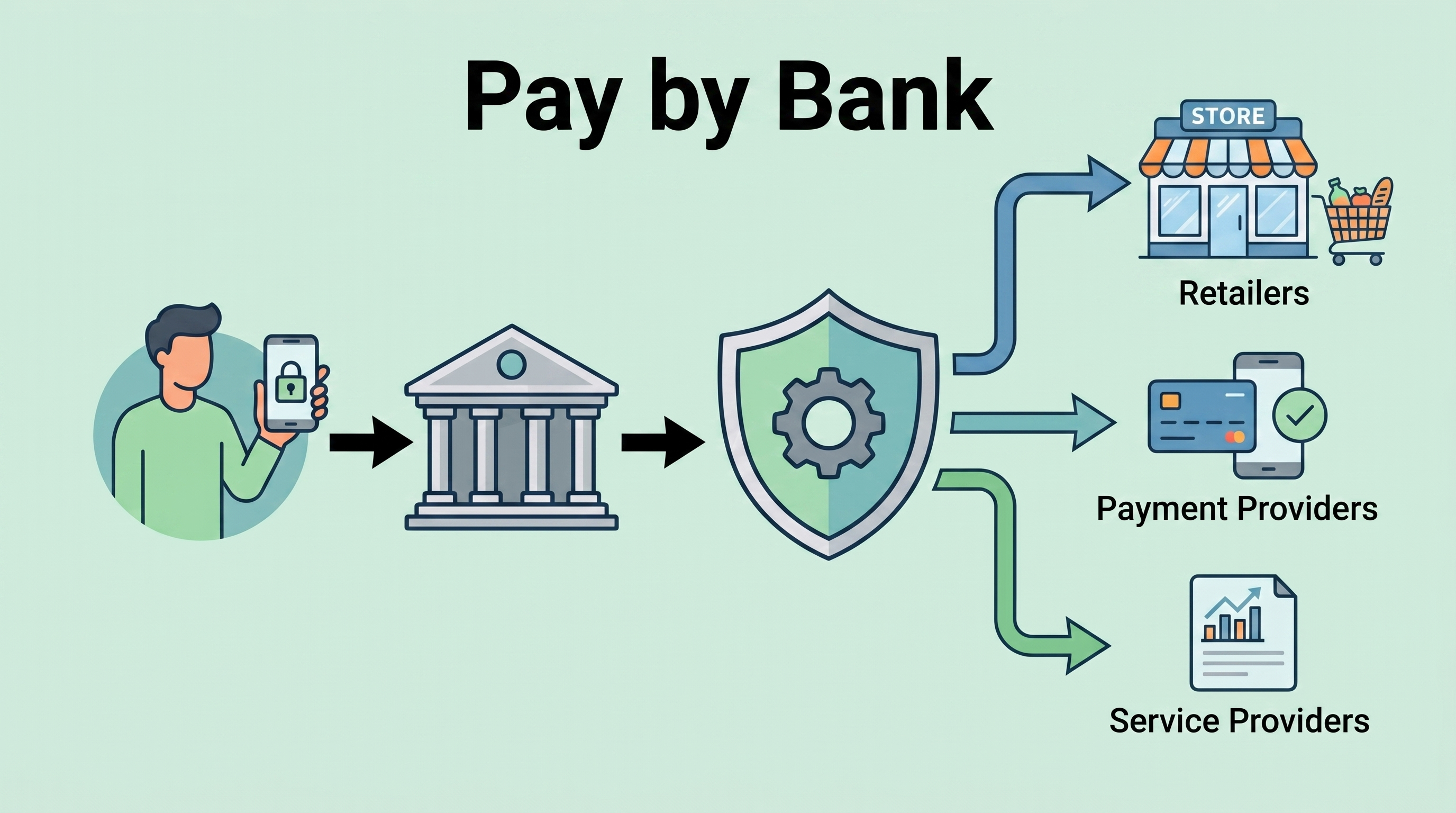
Open Banking enables account-to-account payments through secure APIs, leveraging the UK’s Faster Payments infrastructure to provide near real time settlement. Pay by Bank builds on this infrastructure by allowing customers to authenticate payments directly through their banking app using Strong Customer Authentication (SCA).
From a consumer perspective, the process typically involves selecting their bank at checkout, authenticating via a banking app and completing the transaction securely in real time. For merchants, this provides an alternative to traditional card-based processing.
Market Adoption and Early Developments
Large online marketplaces such as Amazon UK and eBay UK have begun integrating Pay by Bank as part of their broader payment strategies. These organisations operate at scale and can combine payment methods with proprietary buyer protection mechanisms.
However, it is important to recognise that:
- Adoption is still at an early stage across the wider retail market
- The extent of consumer uptake remains uncertain
- Availability is not limited to large marketplaces; Pay by Bank can be implemented by a wide range of merchants
These early implementations demonstrate technical viability at scale but do not necessarily indicate universal adoption patterns or outcomes.
Current adoption appears to be driven primarily by strategic experimentation and cost optimisation initiatives rather than strong consumer demand.
Merchant Considerations Before Adopting Pay By Bank
Before adopting Pay by Bank, merchants should evaluate its relevance within their specific business context, as its value can vary depending on how payments function within the organisation. Key considerations include:
Where will it be offered (online, in-store, omnichannel), and does it work across all customer touchpoints?
How important are payments to conversion and customer experience, and how does this compare to other priorities like reducing card fees?
How likely are customers to adopt Pay by Bank? What would encourage them Loyalty points, cashback or discounts
How will the solution be implemented (e.g. via a PSP or directly with a PISP)?
How will refunds be handled, including speed and process? What are the implications for reconciliation (e.g. individual vs aggregated settlements)?
How will Pay by Bank be supported in non-digital channels?
The Business Case
Pay by Bank may offer several potential benefits, depending on transaction volumes, integration approach and business context.
Cost Considerations
Card payments typically involve fees ranging from approximately 1.5% to 3%. Pay by Bank may offer lower transaction costs in some scenarios, particularly for high-value or high-volume transactions.
However, merchants should assess total cost of ownership, including integration, PSP fees and operational impacts.
Realised savings will depend on customer adoption levels and the proportion of transactions that shift away from cards.
Settlement & Cashflow
Near real-time settlement may improve cash flow and reduce working capital requirements compared to card settlement cycles.
Fraud & Security
Authentication via banking apps using SCA may reduce card-not-present fraud. Additionally, the absence of card data sharing can lower certain fraud risks and PCI compliance burdens.
Chargebacks & Disputes
Pay by Bank does not follow traditional card chargeback processes. While this may reduce chargeback-related costs, merchants must ensure robust dispute resolution and customer support mechanisms are in place.
Barriers to Adoption
Despite its potential, several factors may influence adoption:
Consumer Protection
UK consumers are familiar with protections associated with card payments, such as Section 75 protections and chargebacks. The absence of directly equivalent protections in Pay by Bank may reduce consumer confidence and impact adoption.
User Experience & Friction
Pay by Bank often requires redirection to a banking app for authentication, which can introduce additional steps compared to stored card or digital wallet experiences. While this may impact conversion, it is largely outside the retailer’s direct control.
Consumer Incentives
Unlike some card payments, which may offer rewards, cashback, or financing, Pay by Bank typically lacks inherent incentives. Additionally, some UK banks offer cashback on debit card spending at specific retailers, further reinforcing existing payment behaviours. Merchant-led incentives may therefore be required to encourage adoption.
Revenue Considerations
Retailers with proprietary credit offerings or interchange related revenue streams should assess the potential impact of Pay by Bank on existing revenue models.
Collectively, these factors suggest that adoption is likely to be gradual and dependent on both merchant-led initiatives and broader ecosystem developments.
Strategic Positioning & Practical Considerations
Pay by Bank is best positioned as part of a broader payment strategy rather than a standalone replacement for card payments.
Its role will vary:
- For some merchants, it may support cost optimisation and improved cash flow
- For others, its relevance may be limited by customer preferences or operational constraints
Merchants may consider the following actions:
- Assess its relevance within the broader payments strategy rather than adopting it in isolation
- Evaluate fit based on business model, channels, and customer behaviour
- Compare integration approaches (PSP vs direct integration)
- Ensure operational readiness across finance, reconciliation, and support functions
- Review impacts on cash flow and working capital
- Consider customer incentives where appropriate
- Pilot the solution before scaling adoption
- Monitor performance and customer uptake
Pay by Bank should also be evaluated alongside other optimisation levers such as:
- Digital wallet adoption
- Checkout experience improvements
- Fraud management tools
- Conversion optimisation strategies
Conclusion
In practice, Pay by Bank is most relevant where transaction values are high, card fees are a material cost driver, or account-based payment flows are preferred.
Pay by Bank is an emerging payment option within the UK retail ecosystem, enabled by Open Banking and real-time payment infrastructure. It is accessible to merchants either through direct integration or via existing Payment Service Providers (PSPs), although overall adoption and consumer usage levels are still evolving.
In addition, developments such as Variable Recurring Payments (VRPs) may further expand the potential use cases of Pay by Bank, particularly in areas such as groceries, subscriptions and other recurring payment models.
Rather than viewing Pay by Bank as a universal solution, retailers should assess its suitability within the context of their specific business models, customer base, and operational capabilities.
When implemented thoughtfully alongside existing payment methods, it may offer benefits in cost efficiency, settlement speed, and fraud reduction. However, careful consideration of customer experience, operational complexity, and adoption dynamics is essential in determining its strategic role.
As the Open Banking ecosystem continues to evolve, the role of Pay by Bank is likely to become clearer; however, in the near term, adoption is expected to remain selective rather than universal.
CBS Change Partners have 20 years of experience across the evolving payments landscape. We can help you identify the opportunities, reduce the risks, and implement a practical strategy to unlock the full value of Pay By Bank
Retail Perspectives #6 : Pay By Bank